

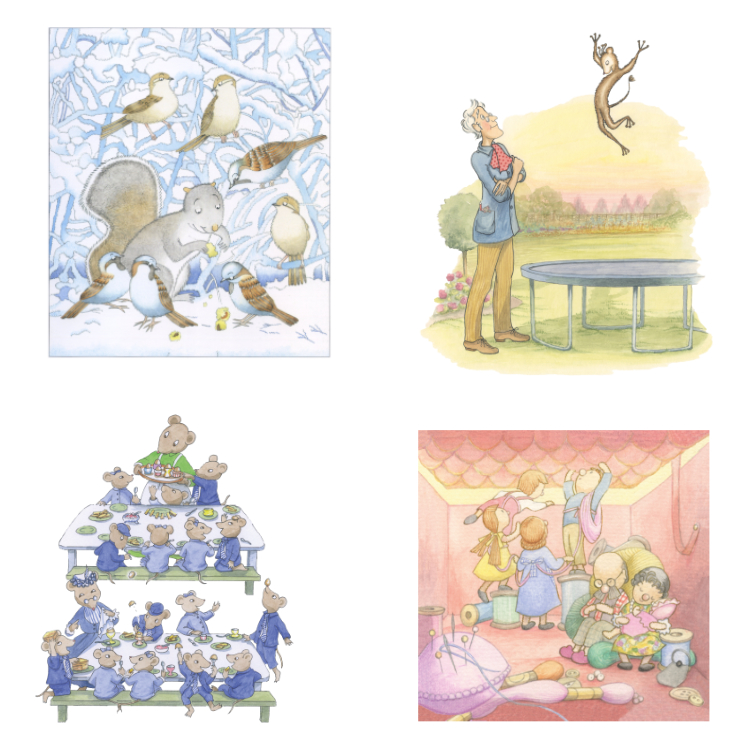

Writing and illustrating a children’s picture book can be an exciting, challenging project. It is best to have some understanding of the age group that the picture book is intended for. The Goldcrest Gallery children’s picture books are all suitable for the under-5 age group. It is important that children of this age prepare for reading by sharing and enjoying books with adults.
Illustrations in Children’s Picture Books
The illustrations are a vital part of this interaction. As the adult reads the story aloud, the child will listen to the story and look at the pictures. The text explains what is happening in the illustrations, and the illustrations enlarge upon what is happening in the text. Young children will be acquiring vocabulary as they listen, helped by the pictures.
With this age group, there are two key things for the author/illustrator to consider. One is how to hold young children’s attention, the other is how to lead their focus over the pages from left to right. The attention span of a two or three-year old child is quite limited, so the story must be compelling. The text should be simple, direct and move steadily from page to page without any delay.
Each page turn needs to lead on from the one before in a clear progression. It is helpful if the illustrations are varied in their overall colour scheme. This keeps the children’s interest. Illustrations for this age group should try to show the main character on each page. The composition of the pictures should be straightforward. Complexity, unusual angles, distortions or unnaturalistic objects all make it difficult for young children to understand the story from the pictures. It should be easy for children to pick out the main storyline in the illustrations (see ‘Professor Popple and the Little Furry Creature‘).
Reading from left to right
As young children will soon be learning to read from left to right, it is very helpful if the author/illustrator keeps this in mind. The pictures should be designed with the sequence of action moving from left to right in each double page spread. Sequential single illustrations on facing pages encourage the children to begin with the left hand picture and move on to the right hand one (see ‘A New Friend for Squirrel‘).
The stories for children’s picture books need to contain drama or humour, or both (see ‘Bed and Breakfast‘)! Repeated phrases and rhythms, rhyming text, and expressive questions or exclamations will quickly become familiar to children, adding to their enjoyment. Memorising text is part of the process of learning to read (see ‘The Snippets‘). Certain repeated words or phrases may come to be recognised by young children, even before formal reading lessons have begun.
In all this, the author/illustrator plays an important part. A well-written and designed children’s picture book will not only provide enjoyable entertainment. It will greatly help the adults who read it, and the children who share in it, to begin the exciting journey towards independent reading.