

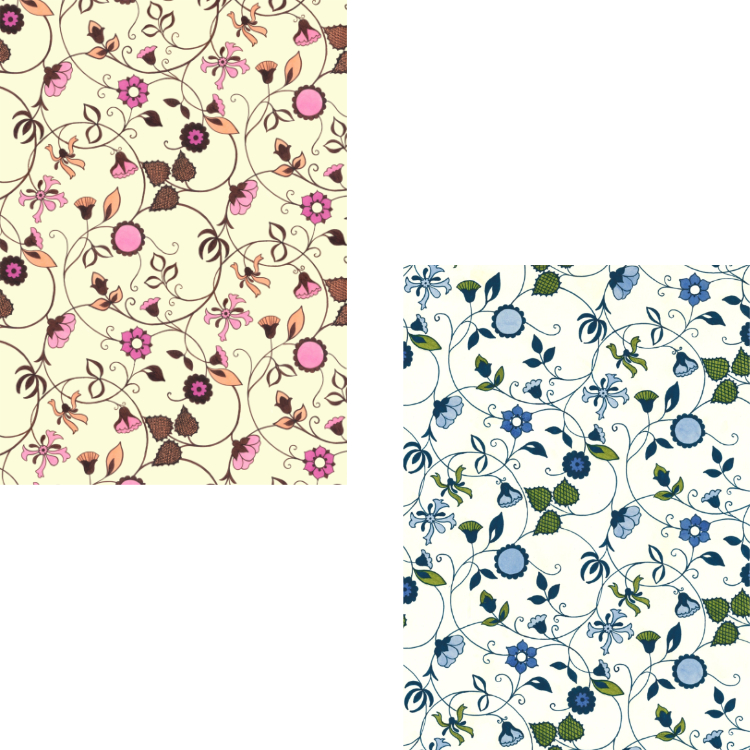

Many of the lovely vintage patterns in the Goldcrest Gallery collection are original textile designs. Most of them were created in the 1970s, before the advent of computers and tablets. Textile designing involved a great deal of careful draughtsmanship and hand painting at that time.
Once the designer had sketched an initial idea for a textile design, it was transferred on to layout paper. This fine, semi-transparent paper was placed over a grid, which helped to position the motifs accurately. It also helped with scaling the proportions of the work up or down. The finished drawing was then traced onto cartridge paper using a light box. Our greeting card design, ‘Lavender Maze‘, shows how using a grid assisted the layout of a complex design. Each design was subsequently painted in gouache, using fine sable brushes. The paint colours were pre-mixed and stored in china cabinet saucers to keep them from drying out.
Repeat Patterns in Textile Designs
Textile designs consist of a primary motif arrangement that is repeated to cover a piece of fabric. Repeats can be symmetrical mirror images. Alternatively, they can be designed with vertical rows in which the motif is moved downwards in a full or half drop. Our lovely design, ‘Pink Posy‘, is a good example of this. The emphasis of the textile design may be diagonal, horizontal or vertical. Sometimes, the textile designer chooses to conceal the repeat as much as possible. By this means, a continuous surface pattern is produced without interruption, as in our fine art print, ‘Cross Stitch‘. Continuous surface patterns are particularly useful for floral designs, giving an impression of a random natural flower arrangement. As well as florals, the designer can base patterns on geometric shapes (such as in ‘Pageant‘), abstract motifs, or representational illustrations of, for example, animals or buildings.
Scale and Colourways
The textile designer has to bear in mind the scale that is suitable for the images. A dress textile pattern will usually be smaller than a furnishing fabric design. Contemporary designers are able to enlarge or reduce the scale of their designs with a touch of the screen. But in the 1970s, these alterations had to be hand-traced, using an image projected from an enlarger.
Modern digital tablets make it possible to produce a range of colourways for a textile design relatively quickly. In the 1970s, each colourway had to be hand painted separately, which was a time-consuming process. But alternative colourways have always helped to sell original designs, then and now (see ‘Honeysuckle Pink‘ and ‘Honeysuckle Blue‘). A different look can be achieved just by altering the backdrop colour of the design. Again, this would have involved a great deal of hand painting in the 1970s.
As a result, the quantity of design images now available far exceeds what was once possible to produce in the 1970s. However, a beautifully hand-painted original textile design always has a special quality, and becomes a work of art in its own right, as the lovely images in the Goldcrest Gallery collection can prove.