

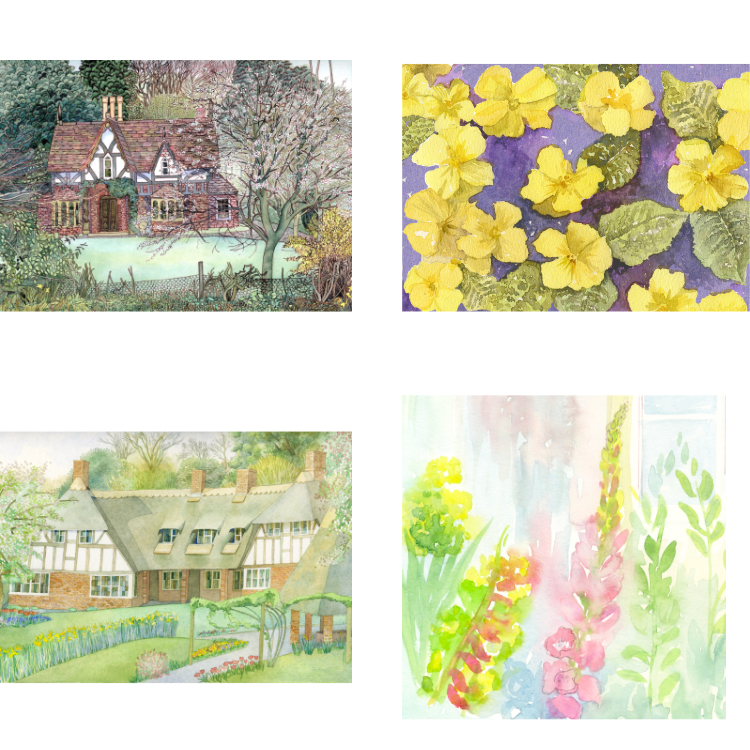

As watercolour can be a difficult paint medium, good preparation for painting is important. Choose the best quality watercolour paper you can afford. A 300gsm cold pressed paper will repay you by withstanding multiple overlaid watercolour washes. A fair amount of ‘working into’ with the brush will not spoil the surface of a substantial watercolour paper.
It is also unnecessary to stretch heavier papers as they do not buckle or warp when wetted. If you prefer to work on a good quality cartridge paper, this should be placed on a dampened drawing board. The paper can be lightly moistened at this point. Then each side can be stuck down using gummed paper tape. When the damp paper dries, it will be stretched taut at the taped sides. Subsequently, when watercolour washes are laid on the paper, it will dry flat.
Brushes
Brushes are another essential element in producing good watercolour washes. As with paper, the best quality brushes make it easier to work in this medium. Select a pure sable brush (or good quality vegan alternative) from a reputable manufacturer. This sort of brush holds the watercolour paint better, giving you more time to work before needing to replenish the brush load. The tip of the brush will keep its shape well so you can be in full control of where you are placing the colour.
Line and Wash
Many watercolourists draw with pen and ink first, particularly for illustration. The watercolour wash is then painted either up to the lines or over them, as in our greeting card ‘Country Cottage‘, for instance. Pencil drawings may also be used, but the lines are less visible when painted (see ‘Primroses‘ in our greeting card collection). And watercolour washes are sometimes applied freestyle with no line drawing at all, as in our greeting card, ‘Watercolour Garden‘.
Applying Watercolour Washes
A watercolour wash is laid onto wet or dry paper. Wetting the paper helps the wash to spread out smoothly and evenly. It also delays the drying process on the paper surface, keeping the paint wet. Other colours can be blended in quickly at this point. Tilting the paper on its board and applying a wash at the top causes the paint to spread evenly down the page. If you want to create a looser, more fluid style of wash with colour variations, then laying the paper flat will probably be more helpful.
Watercolour can be applied in a single wash or in layered washes. Care must be taken not to lift the underlying washes if they have not dried completely. Wash techniques are frequently used in watercolour landscapes, as the very wet paint covers large areas easily and spontaneously. There is an example of this in ‘Laverstoke‘, one of our greeting cards.
View our Watercolour Washes Edit of selected watercolour designs, visit the Goldcrest Gallery greeting card collection, and browse our Children’s Corner – you’ll find many beautiful watercolour paintings and illustrations to enjoy!