


The story of dolls goes back almost to the beginning of recorded civilisation. In fact, dolls are considered to be the oldest known toy. Early dolls have been documented from ancient Egypt, Rome and Greece. They were crudely and simply made from clay, wood, textiles, bone, ivory or leather. Wooden dolls carved in a paddle shape originate from Egypt in the 21st century BC. Articulated dolls with moveable arms and legs date back to 200 BC or earlier. Ancient Greek stories reveal that dolls were played with by young girls. In ancient Rome, clay, wood and ivory were used to make dolls. Some Roman rag dolls have been discovered which date back to 300 BC.
Early European Dolls
In many cultures dolls play a part in religious traditions. In Italy, from about the fifteenth century, dolls were developed for nativity scene displays. These later dolls were more elaborate and artistically designed. Modern manufactured dolls began to be produced in Germany from the fifteenth century onwards. Porcelain gave dolls a more realistic appearance, and increasing industrialisation enabled them to be mass produced. Blue glass eyes for dolls began to be favoured during the Victoria era.
Baby Dolls
Dolls were usually created to resemble adults. But around 1850, there was a new development in the story of dolls: childlike and baby dolls began to appear. By the late 19th Century, these were the most popular types of dolls. In the 1920s, baby dolls were made with cloth bodies, and composition heads and limbs. Their facial features were painted. Dolls became sought after by collectors during the twentieth century. From the mid-twentieth century, dolls were mass produced using plastic and vinyl. Porcelain and plastic dolls were made especially for adult collectors.
The Story of Dolls
During the 1950s, popular children’s author, Enid Blyton, wrote many story books about dolls, for example ‘The Dancing Doll‘. The tradition that dolls come to life when no one is there to see has continued in modern Disney Pixar films, such as ‘Toy Story’. And Disney now manufacture dolls representing key figures from their films, particularly Princess dolls, like Cinderella and Snow White.
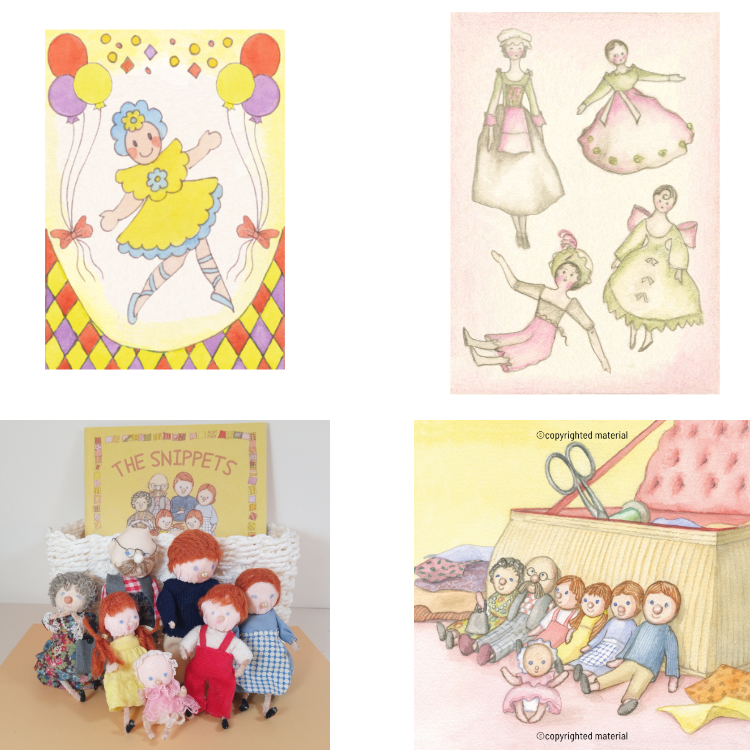
Our Goldcrest Gallery range of Little Notes includes an intriguing design illustrating four tiny antique wooden peg dolls. There is a ballerina doll in our ‘Mini Messages – Circus Friends‘ set. And, of course, we have a delightful children’s book which is all about a family of diminutive pipe-cleaner dolls, ‘The Snippets‘!