

Photography has had both positive and negative effects on art. Traditionally, artists were relied on to record how things looked. Patrons commissioned portraits, paintings of their homes and lands, and even their favourite horses and dogs. This can be seen in the work of Sir Joshua Reynolds, Gainsborough and George Stubbs. It was part of the artist’s role to record battles and victorious commanding officers. Explorers made engravings of newly discovered animals and plants. But photography eventually provided a much quicker, cheaper and more accurate way to capture how all these things appeared. This took away much of the artists’ livelihood. Painted portraits were still prized, but for the general depiction of reality, artists no longer held the monopoly.
In response to this, artists and sculptors had to discover a new raison d’être. While designers of the decorative applied arts were less affected by photography (even with mass production), the fine artists had to explore other avenues for their work. This could be called freedom, because artists expressed their own feelings, ideas and preferences. They no longer had to ‘conform’ to the tastes of their patrons. But it can be harder for artists to support themselves with the sale of such artwork. They often need to supplement their income with other work.
Photography and Composition
Photographs have an immediacy, particularly in composition, which has had a great effect on art. The camera lens can shoot angles and close ups that are more visually exciting than the traditional, formal, classic views of people and places. Modern artists picked up on this new dynamic. Abrupt cut offs, asymmetrical compositions, unusual view points and informal angles have all been incorporated into the modern art vernacular. The ballet paintings of Impressionist artist Edgar Degas, are a good example. Apart from representational accuracy, the paintings of Degas resemble photographs in their composition.
Abstraction
Ultimately, the freedom from compositional and representational ideals brought about by photography ended up in abstraction. In this type of artwork, colours and shapes are arranged freely to express the artist’s personal preoccupation. This can be seen in the work of Sir Terry Frost RA, for instance. In artwork of this kind the viewer plays a reactive part, forming judgements and reaching conclusions that are influenced by personal ideas, feelings and memories.
Photorealism
But photography has also had an opposite effect, that of photorealism. Because a photograph records a person, place or object in a permanent, detailed form, the artist is able to refer to it while painting or drawing. Transience can thus be captured in a painting as accurately as in a photograph. Hyperrealism aims to create a drawing or painting which looks as if it is a photograph. This is a popular genre for wildlife artists. For all artists and designers, photography is an invaluable tool aiding them in their work. They do not have to rely on their own sketches for reference material.
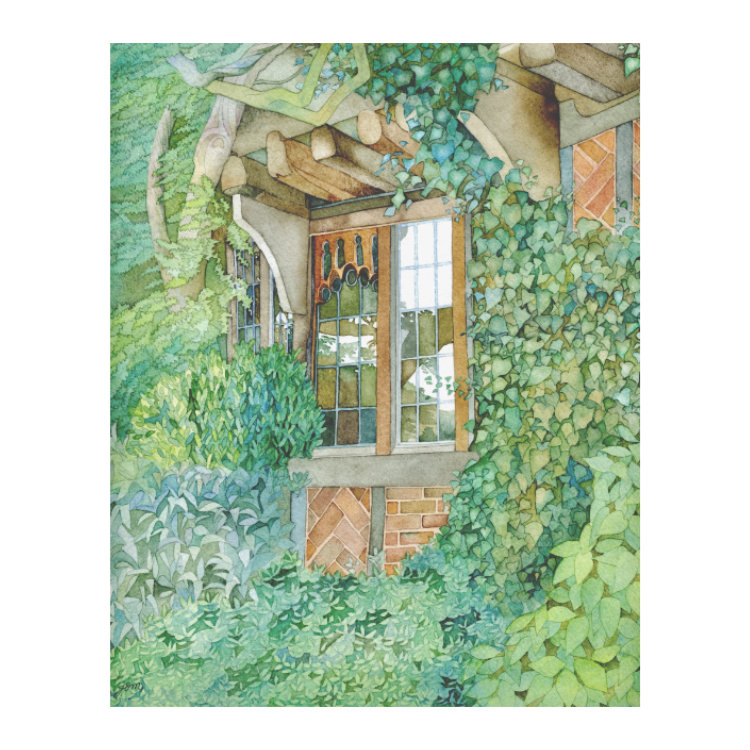
Several of the designs in the Goldcrest Gallery collection have been created using photographic references. They include ‘Cottage Window‘, ‘Winter’s Day‘ and ‘Laverstoke‘.
Enjoy visiting our collection of beautiful fine art cards and prints!