

Acrylic, gouache and watercolour are all water-soluble paints, although they have different properties. Watercolour is the oldest paint type of the three, and has been known almost since the time of cave painting. It has been utilised to illustrate manuscripts since ancient Egyptian times, and especially in the Middle Ages. Later, during the Renaissance, watercolour became a medium for fine artists. Gouache was used by the Chinese thousands of years ago, but it became popular in Europe during the 16th Century. Acrylic, the most recent paint type of the three, was first developed in 1934. It was used in the 1940s as a paint for houses and cars. But by the 1960s acrylics had become very popular as an alternative to oil paints.
Watercolour
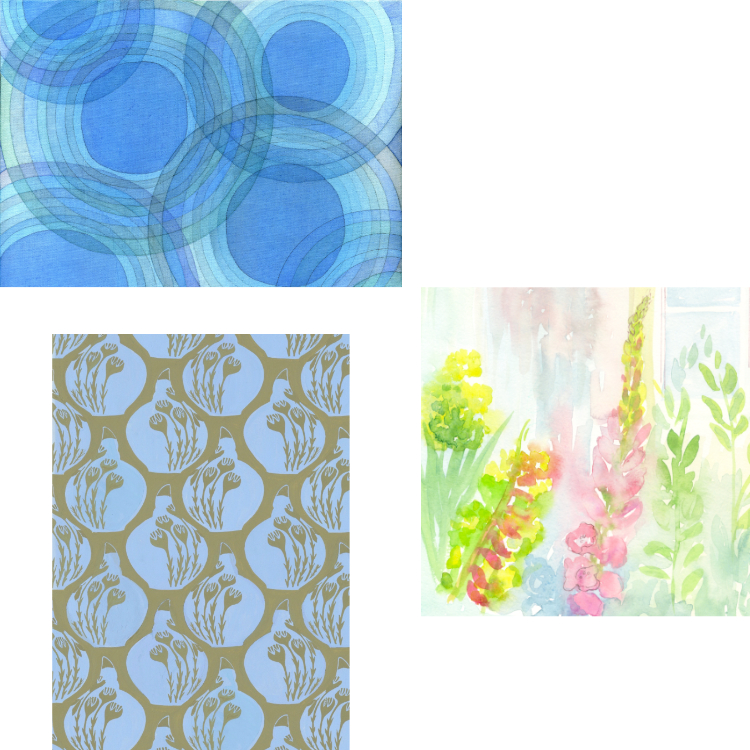
Traditionally, watercolour is considered the most difficult paint medium to master. Any mistakes cannot often be removed because the paint sinks deeply into the paper surface and stains it. The transparent nature of watercolour makes it hard to cover up any errors. Additionally, the watercolour paint soon starts to look non-transparent if it is overworked. Watercolours may lack richness because they are not densely pigmented. When thinned with water, the colour of the washes may become much lighter, so that several layers of washes are needed to produce a deep enough colour. In addition, watercolours may fade quickly in strong light, especially pink hues. However, nothing can match the beautiful luminosity of a translucent watercolour when it has been painted skillfully (see ‘Watercolour Garden‘).
Gouache
Unlike watercolour, gouache paint is opaque in nature. It contains much more pigment and so it can produce significantly more saturated colours. There is also more of the binder Gum Arabic in gouache paint than in watercolour. This means that mixing a little water with gouache does not result in a thin wash, as with watercolour. Instead, a smooth, rich, creamy texture is obtained. The colour can be applied with watercolour brushes in a perfectly matte opaque surface, with no streaks (see ‘Chinoiserie‘). Coupled with the brilliance of the colours, this smooth opacity makes gouache the medium of choice for designers. However, skill is needed to match colours, which dry darker than they appear when wet. As well as this, gouache dries fast, so blending colours is challenging. The paint must not be applied too thickly, because this leads to cracking when dry. Gouache paintings are slower to fade, compared with watercolours. Artists have used gouache for animation backgrounds and open air sketches. Typically, an inexpensive type of gouache is available in most schools as the first introduction to painting for younger children.
Acrylic
Acrylic paints can be very versatile. They can be used instead of oil paints and are less likely to yellow with age. The colours are more resistant to fading than either gouache or watercolour. The earlier types of acrylic paints, from the 1960s to 1970s, needed a great deal of mixing to obtain a smooth colour. However, acrylic colours are now much easier to mix and thin down with water. They also dry much faster than oil paints, and artists sometimes add a retarder to slow down the drying process so that they can continue to work into the paint. Unlike gouache and watercolour, which can be lifted off the painted surface if wetted again, acrylics form a waterproof barrier. This makes them highly durable and easy to paint in layered washes on top of each other (see ‘Blue Pools‘). Nevertheless, the speed at which acrylics dry means that obtaining a smooth, streak-free wash is tricky, especially on paper (see ‘Tulips‘).
Contemporary artists are fortunate to have acrylic, gouache and watercolour paints to choose from. Their high quality and reliable standards assist artists greatly. With these superb modern materials at their disposal, they can create wonderful effects and express their ideas in almost unlimited ways!